Members of ATA’s German Language Division (GLD) and its local chapter, the New York Circle of Translators (NYCT) met up at a Stammtisch on Wednesday, June 10, 2026, in Manhattan. At the informal meeting, members were able to catch up with each other, share about their work, and learn about other activities in the world of translation. The day ended with an awards ceremony for literary translators at Goethe-Institut New York.
GLD and NYCT Stammtisch in Gramercy Park
GLD admin Karen Leube visited New York City on Wednesday as part of the planning for a conference in spring 2027 to celebrate the 30th anniversary of the German Language Division, and members of NYCT and ATA arranged a meetup at a nearby café, where a number of topics of broader interest were discussed.
- The GLD’s distinguished speaker for ATA 67 will be award-winning German-to-English translator Michael Hofmann who will hold two sessions at the conference taking place from Oct. 28 to 31 in San Francisco. Registration is now open! Note: The earlier you register, the more you save!
- NYCT is hosting events this summer such as a World Cup watch party. Spoiler: The result was a terrific goalless draw between Spain and Cabo Verde. Please also save the date for International Translators Day on Saturday, September 26!
- Members also spoke about the activities of the American Council on Germany (ACG). ACG is an independent, nonpartisan nonprofit organization founded in 1952 to strengthen German-American relations and the transatlantic partnership. Be sure to sign up for their emails – it’s a great way to keep up with political news and learn more about their events, which are open to the public, often at no charge.
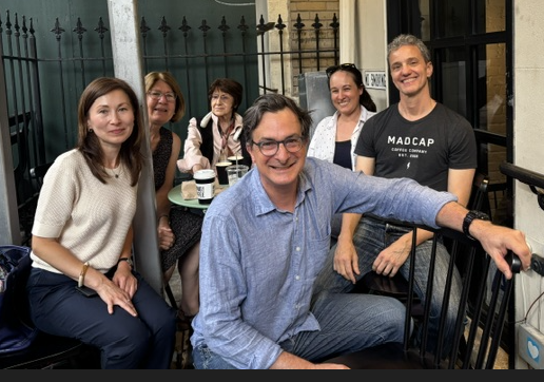
[Caption:] Kaffeeklatsch (from left): Regina Geffner, Karen Leube, Renate Stein, Matt Griffin, Liz Herron-Sweet, and Randal Gernaat at a Stammtisch on Wednesday, June 10, 2026.
Translators Honored at Goethe-Institut New York
There was a special treat in the evening of June 10, 2026, when two prizes for German literary translation were awarded at a ceremony at Goethe-Institut New York: The Helen & Kurt Wolff Translator’s Prize and the Gutekunst Prize of the Friends of Goethe New York.
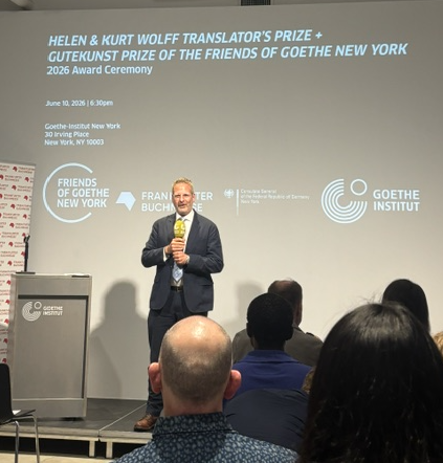
[Caption:] Goethe-Institut New York executive director Jörg Schumacher welcomed guests at this year’s awards ceremony and acknowledged the support of the Friends of Goethe New York, the Frankfurt Book Fair, and the German Consulate General New York.
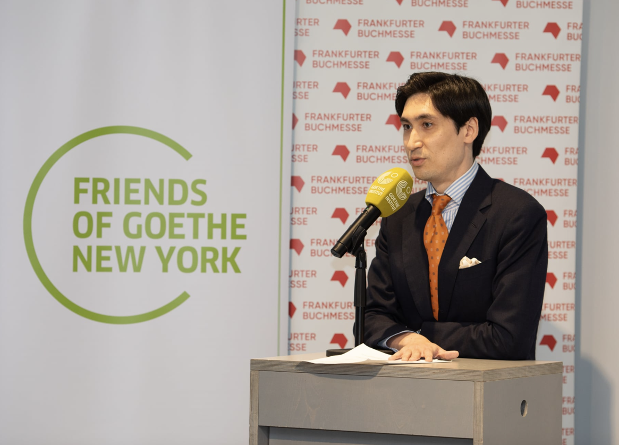
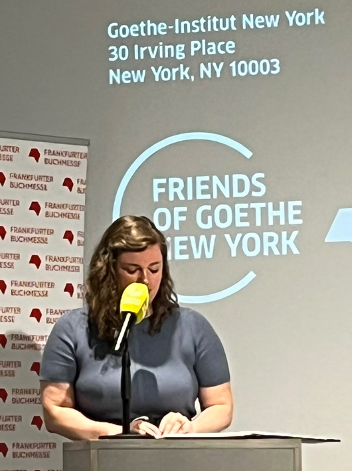
[Caption:] Goethe-Institut New York literature & translation manager Dean Whiteside emceed the evening that included statements from jury members Alta L. Price (Gutekunst), Shelley Frisch (chair Wolff) and Philip Boehm (Wolff), as well as readings and acceptance speeches by the winners. “I always know when the weather in New York starts to get hot and sticky,” he added. “It’s time for the annual Helen and Kurt Wolff Translator’s Prize.”
The recipients of this year’s awards are Max Lawton for the Wolff Prize and Sylvia Cunningham for the Gutekunst Prize. Lawton won for his translation of Michael Lentz’s Schattenfroh (Deep Vellum, 2025), and Cunningham for her translation of an excerpt from Maren Wurster’s Hier bleiben können wir auch nicht (Piper Verlag, 2025).
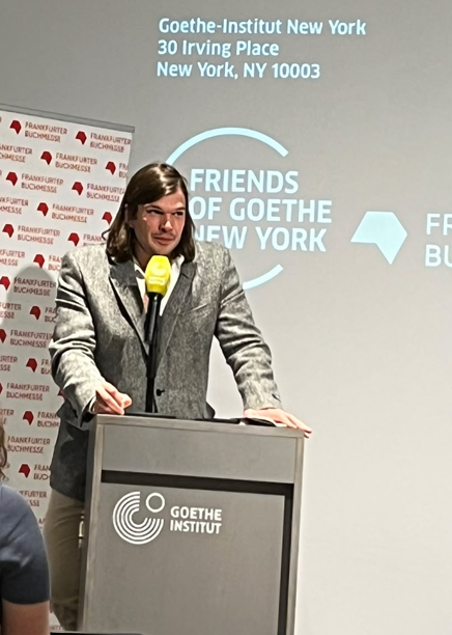
[Caption:] Max Lawton, winner of the 2026 Helen & Kurt Wolff Translator’s Prize.
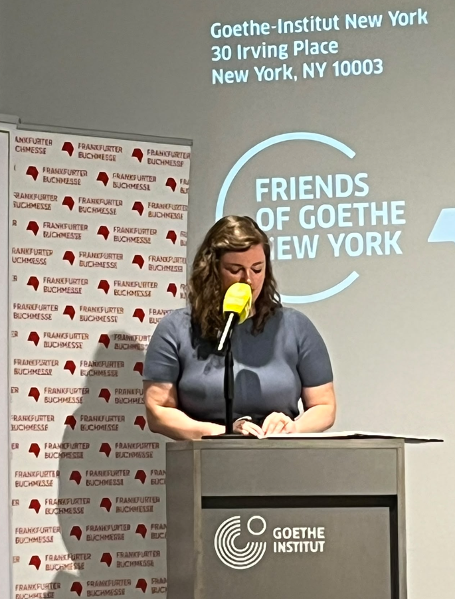
[Caption:] Sylvia Cunningham, winner of the 2026 Gutekunst Prize of the Friends of Goethe New York.
The Wolff Translator’s Prize honors an outstanding literary translation from German into English published in the US and Canada the previous year. The Gutekunst Prize recognizes an outstanding young translator of German literature into English and assists them in establishing contact with the translation and publishing communities.
The event was held at 30 Irving Place, NY, in the Union Square and Gramercy Park area, where the Goethe-Institut’s beautiful library is housed in a public space for anyone who wants to read, listen to music, watch films, or meet other people. Check out their online library offering here.
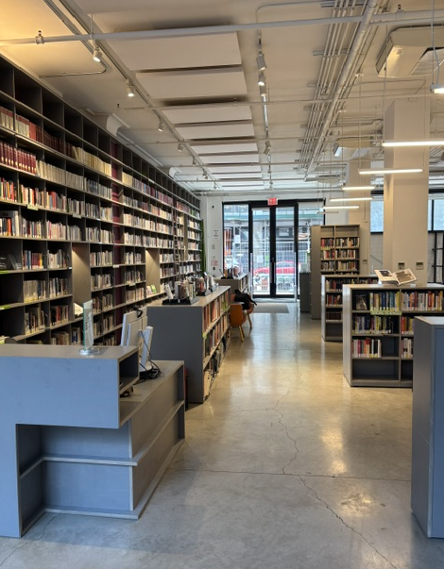
[Caption:] Goethe-Institut New York: German-language lending library at 30 Irving Place, NY. Can you spot the iconic red and black cover of the 100-volume German Library?
The Wolff Translator’s Prize commemorates the contributions of Helen and Kurt Wolff, and it honors their work by continuing to promote German-language literature in translation in the US and Canada. It is remarkable today to think about the legacy of the émigré publishers, like the Wolffs or Frederick Ungar, who arrived in New York in the early 1940s. Some 80 years later, it feels like we are living in a golden age of literature in translation, and the legacy of these writers, translators, and publishers, who sought to promote world literature and foster international communication, is evident today in the work of publishers, non-profits, and associations, in addition to awards such as the Helen & Kurt Wolff Translator’s Prize.
In his acceptance speech, Max Lawton spoke about risk, and he thanked his publisher Deep Vellum Press for taking the risk on a book that the jury for the award described as a “sprawling, experimental ‘requiem’ [that] defies classification as it roams across history, religion and mysticism, shifting like shadows.” Such works also require their translators to take risks, and it was fascinating to hear Lawton talk about the process – and risks – involved in translating Michael Lentz’s Schattenfroh. “Max Lawton’s fearless rendering,” wrote the jury, “matches the author’s inventiveness, polymath expertise, and disregard for orthodoxy.”
It is indeed an exciting time, and the publishing landscape today for literature in translation in North America is rich and comprises both large and (mostly) small presses such as And Other Stories Press, Archipelago Press, Deep Vellum, Farrer, Straus & Giroux, Liveright Publishing, New Directions, New Vessel Press, NYRB Press, Seven Stories Press, Summit Books, The Experiment, Transit Books, Ugly Duckling Presse, World Editions, and many stalwart university presses.
Publishing in the US has changed greatly in the past 30-40 years, and awards like the Wolff Prize or the ATA’s Ungar Award reflect these changes, as the number and variety of presses has grown. I remember when translator John Woods – the first recipient of the Wolff Prize in 1996 – sat alone atop the “magic mountain” at Random House. It was a smaller world back then. Nowadays, there is a vibrant community of writers, editors, publishers – and literary translators – to connect with through events like these.
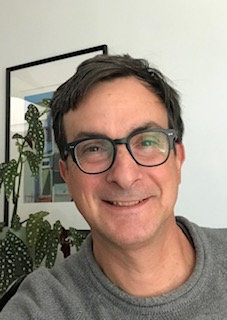
Matt Griffin is a German-to-English translator who lives in Brooklyn, NY. He has a PhD in German Studies, and owns and operates Brooklyn Translation Works LLC, a language services provider specializing in marketing and technical translation. He is also a copyeditor for book and journal publishers, and he writes about art, literature, and theater at his website [https://mbgriffin.com/].