I recently took a daytrip to Philadelphia and visited an intriguing exhibition called The Declaration’s Journey at the Museum of the American Revolution. The show traces the evolution and global impact of the Declaration of Independence since 1776.
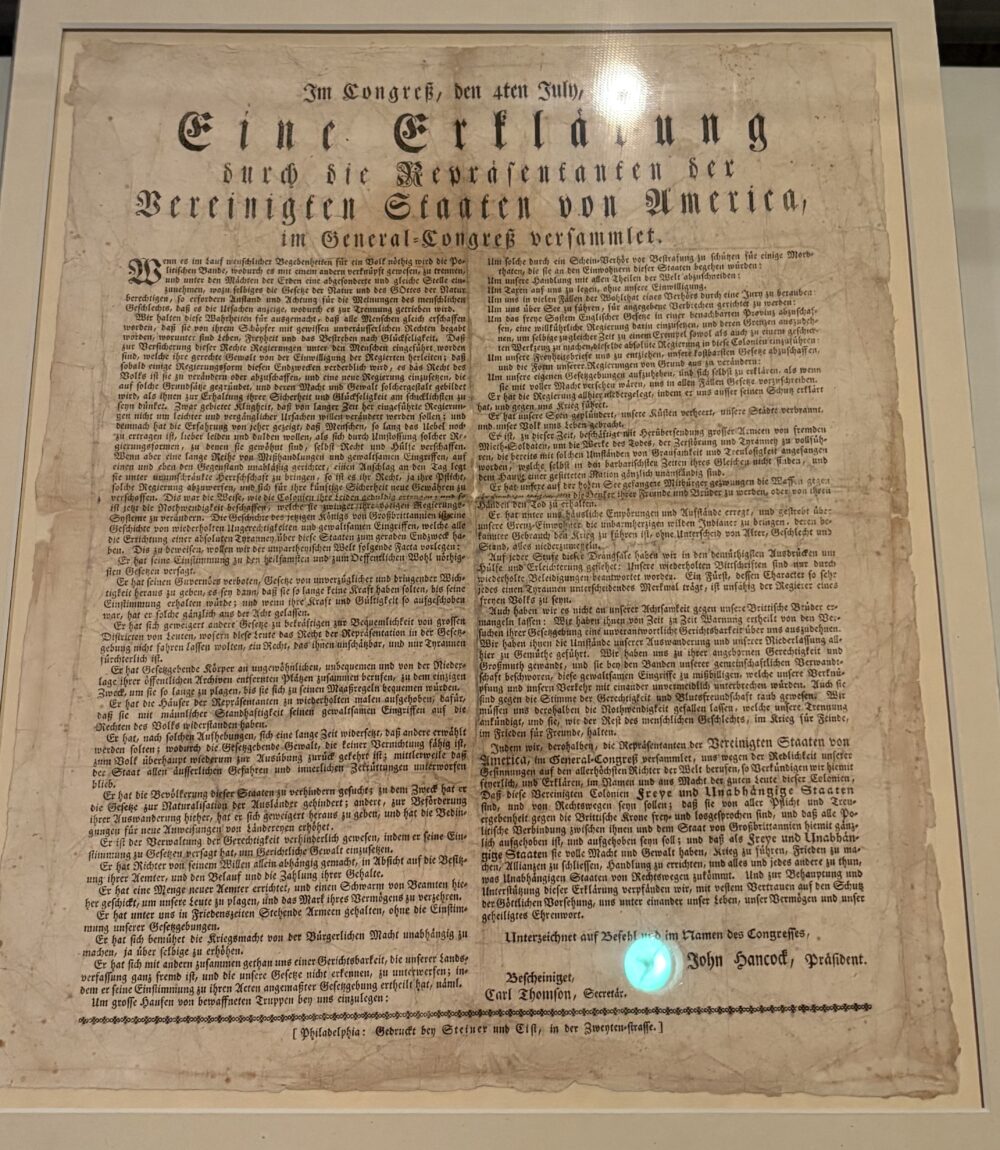
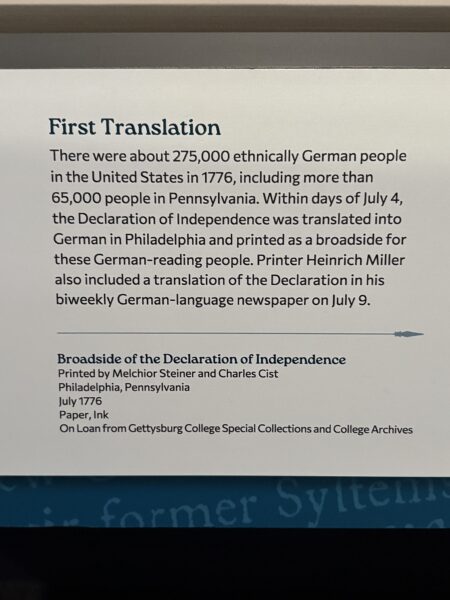
One of the first things a visitor to the exhibition encounters is a rare original broadside copy of the first translation of the Declaration of Independence into German. (Broadsides are large printed pieces of paper that were intended to be hung in public spaces as a way of spreading news.) It was likely printed only a day or so after the publication of the English version, the so-called Dunlap broadside.
Only two copies of the original German broadside translations of the Declaration of Independence are known to exist. The copy on view at the Museum of the American Revolution is on loan from Gettysburg College in Pennsylvania. This document was discovered in 1984 in the Gettysburg College archives by Professor Karl J. R. Arndt (at that time professor of German at Clark University in Worcester, Massachusetts). He later established its authenticity as an original broadside from July, 1776. (The other known original copy is owned by the Deutsches Historisches Museum in Berlin.)
Stumbling across this early translation of the Declaration of Independence piqued my interest in the role of translation as well as the prevalence of non-English languages during the earliest days of the U.S.
The Declaration was immediately translated
According to Professor Arndt, the first announcement of Congress’s Declaration of Independence in the Colonial press was not in an English newspaper. Rather on Friday, July 5th Henrich Miller’s German-language newspaper, the Pennsylvanischer Staatsbote, ran the following announcement, scooping the English-language press:
   Philadelphia, den 5 July.
Gestern hat der Achtbare Congress
dieses Vesten Landes die Vereinig-
ten Colonien freye und Unabhaengige
Staaten erklaeret.
   Die Declaration in Elglisch ist
jetzt in der Presse; sie ist datirt,
den 4ten July, 1776, und wird heut
oder morgen im druck erscheinen.
Given the obvious spelling mistakes, this announcement was certainly a last-minute rush job. The following edition of the biweekly Staatsbote on Tuesday, July 9th contained the full German translation of the Declaration of Independence.
To get a sense of how quickly this German translation was turned around, let’s quickly review the events in Philadelphia in early July, 1776.
- July 4th: Congress adopts the Declaration of Independence and commissions the local printer John Dunlap to produce up to 200 broadside copies overnight for immediate distribution.
- July 5th: The Dunlap broadsides are released. The first announcement of the Declaration of Independence in the Colonial press is published in German in the Pennsylvanischer Staatsbote.
- July 6th: The full original English text of the Declaration is published in the Pennsylvania Evening Post. The translated German broadsides are likely printed as early as July 6th.
- July 8th: The first public reading of the Declaration of Independence takes place in Philadelphia.
- July 9th: The full German-language translation of the Declaration appears in the Pennsylvanischer Staatsbote.
Who was the translator?
Charles Cist is recognized as the first translator of the U.S. Declaration of Independence. He was born Charles Jacob Sigismund Thiel in the German community of Saint Petersburg, Russia in 1738 and emigrated to Philadelphia in 1769. Upon arrival in Pennsylvania, he immediately changed his last name to Cist (the initials formed by his full name). He was employed as an English-to-German translator by Henrich Miller of the Pennsylvanischer Staatsbote. He also formed a partnership with Melchior Steiner, creating the printing company, Steiner & Cist, responsible for publishing the first translated German broadsides of the Declaration of Independence.
The importance of translation in multilingual colonial America
One can see from the printing and publication timeline above how quickly the German translation was available in Philadelphia. This certainly speaks to the importance patriots placed on reaching a broad audience (immigrants, non-English speakers, loyalists, etc.) in making the case for independence, as well as to the importance of translation in the early communication efforts of the fledgling nation.
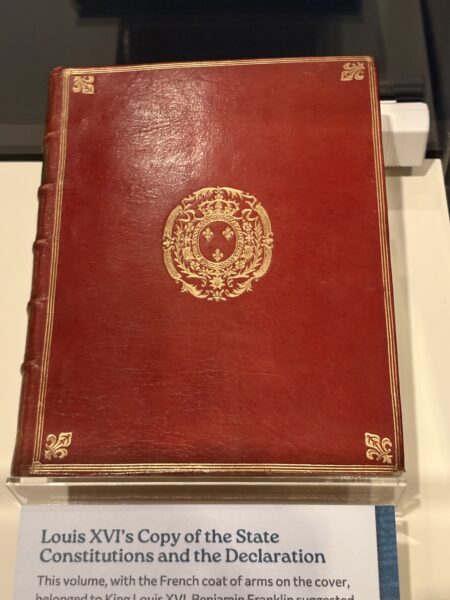
According to the Museum of the American Revolution, the Declaration was also immediately translated into French for the Indigenous Wolastoqiyik and Mi’kmaw chiefs who were negotiating a treaty with the colony of Massachusetts. (Additionally, a beautifully bound copy of a French translation of the Declaration of Independence as well as the state constitutions produced for the French court and owned by Louis XVI is on view in the exhibition.)
According to Timothy Shannon, history professor at Gettysburg College, the fact that a German translation of the Declaration of Independence appeared so quickly shows the political significance of German immigrants. “Generally speaking, recent immigrants were less likely to support the patriot cause than native-born colonists because they were less familiar with the grievances that sparked the Revolution,” said Shannon. “A lot of German immigrants felt a loyalty to the Hanoverian kings, a dynasty with German roots. The patriots were making their case to the large population of German immigrants, if for no other reason than to discourage them from acting as loyalists.”
Scott Stephenson, Vice President of Collections, Exhibitions, and Programming at the Museum of the American Revolution, also emphasized that, “This July 1776 German-language printing of the Declaration of Independence reminds us that the United States has been a diverse, multilingual nation since the moment of its birth.”
In Ken Burns’ recent PBS documentary, The American Revolution, historian Christopher Brown makes the following point: “I’m not sure there is a state, anywhere in the world, in the late 18th century, that has as wide a variety of people who inhabit it, and so, it really is actually kind of remarkable, the way that that nation ends up cohering, not around culture, not around religion, not around ancient history. It was coming together around a set of purposes and ideals for one common cause.”
The documentary also highlights the multilingual nature of George Washington’s army noting his troops spoke German, Irish, Scots, Welsh, Dutch, Swedish, French, Mohican, Oneida, Wolof, Kikongo, and more. And it’s also worth calling attention to the fact that many of the signers of the Declaration were themselves born outside North America and first-generation immigrants.
So as we mark the 250th anniversary of the U.S. Declaration of Independence, it’s worth pondering the important role that translation played in inspiring and unifying many residents in our nascent country. A country that was multilingual and diverse from the very beginning.
[Click here for a recent New York Times article on the other original German-language copy of the Declaration of Independence held by the Deutsches Historisches Museum.]

Randal is a New York City-based German-to-English freelance translator focused on business and economics. He has also worked in the international financial industry as an economics business manager for over 20 years. He currently serves as the German Language Division’s Web Manager and Treasurer for the New York Circle of Translators.